
A hollow plastic Santa lit from inside did not exist before the early 1960s — the resin and the equipment to blow-mold something that large only came together then. Four companies built the whole category, one of them patented nothing and trademarked its ornament line instead, and the year everyone repeats for the first one was never checked against a federal record.
The short version
- Blow-molded polyethylene decorations could not have existed before the early 1960s. A listing dated to the 1940s or 1950s is describing the wrong object — injection-molded or celluloid figures existed then, not blow molds.
- Beco Products of Chicago is credited with the first fully three-dimensional blow-mold Santa and sleigh set, around 1963–64. That claim comes from one specialist history article, not from a patent, trademark, or catalog Owl and Twig could independently verify.
- Poloron Products filed a federal trademark for "decorative plaques and seasonal ornaments" on July 26, 1967 — two years before the 48-inch choir figures usually cited as the company's signature product.
- No design patent could be found for a Union Products, Poloron, Beco, or Empire blow-mold Santa. The pink flamingo's mold was never patented either; this looks like the same pattern repeated across the industry.
- Union Products closed in 2006 and was revived by Cado Products in 2010; General Foam Plastics, which had absorbed both Beco's and Empire's holiday lines, closed in 2017. Nearly everything now sold new is a Chinese-made reproduction.
On this page
Why nothing sold before the early 1960s is real
Blow molding fills a hollow steel cavity with melted plastic, then forces it against the mold's interior walls with compressed air before it cools into a hollow shape. The process itself dates to 1881, when Celluloid Novelty Co. of New York took the first U.S. patent on it, but the material that made a life-size lit Santa practical did not exist yet. Cellulose acetate arrived in the 1930s, low-density polyethylene in the 1940s, and high-density polyethylene and polypropylene in the 1950s — and it was only once that last generation of resin was cheap and available that manufacturers could blow-mold something the size of a lawn Santa in enough volume to sell at a retail price.
Consumer Christmas blow molds followed immediately after: every specialist history of the category places the first commercial examples in the early 1960s, not before. A dealer listing dated "1940s" or "1958" for an actual blow-molded Santa is describing an object that could not have been manufactured on that date with that process. Plastic Christmas figures from the 1940s and early 1950s exist, but they are injection-molded (hard, even-walled, pieces glued or bonded together) or made from painted celluloid or composition — a different object from the hollow, one-piece blow mold this guide covers.
The fast visual check. An injection-molded or celluloid Santa is built from separate hard pieces joined at seams you can see and feel. A blow mold is one hollow shell, lit from inside, with a single mold-parting seam running around its full circumference — not glued panels. If a "vintage" listing shows glued or screwed-together solid parts and calls it a blow mold, the seller has the construction method wrong, whatever decade they've written down.
The four companies, and the claim with no source
Four manufacturers built essentially the whole category, and their founding dates predate the blow-mold Christmas business by a decade or more in every case:
Poloron Products had operated out of New Rochelle, New York since 1937, making insulated picnic jugs and coolers, long before it touched a Christmas decoration. Union Products was founded in Leominster, Massachusetts in 1946 as a plastics manufacturer with no holiday-decor focus at all. General Foam Plastics was started in Portsmouth, Virginia in 1957 by two former Cornell roommates, Burk Zanft and Ascher Chase, out of a 1,500-square-foot warehouse making styrofoam pipe insulation and pool toys. Empire, based in Tarboro, North Carolina, traces to a company called Judith Novelty Sales around 1953, though the specialist source for that date does not itself cite a primary record, and this guide could not independently confirm it.
The company most often credited with starting the category itself is Beco Products of Chicago — formerly the Bernard Edward Co. — which one specialist magazine history states produced "the first fully three-dimensional blow-molded Santa and sleigh set sold to consumers" around 1963–64. That claim is worth repeating with a flag on it: it comes from a single trade-press history article, not from a Beco catalog, a trademark filing, or a patent this guide could locate and check independently. No design patent for a Beco Santa or sleigh mold surfaced in a Google Patents search, and no Beco or Bernard Edward Co. trademark record could be found on Justia's federal database. The "first" claim is plausible — Beco was old enough (active since at least the late 1940s) and was later judged valuable enough that General Foam bought its Christmas division outright — but it rests on secondary reporting, not a document with a filing date on it.
The one federal record that actually dates a line
One piece of primary-source dating survives for this category, and it belongs to Poloron, not Beco. On July 26, 1967, Poloron Products Inc. filed federal trademark serial 72276862 for the word POLORON, covering "decorative plaques and seasonal ornaments" — filed the same day as two related marks covering picnic jugs and outdoor grills, the company's older core business. That filing is a real, dated federal record, and it places Poloron's holiday-decoration line in commerce no later than 1967.
That date runs two years ahead of the product Poloron is actually remembered for. The company's 48-inch choir figures — still the item collectors search for by name — are usually dated to 1969 in specialist histories, alongside "improved sleigh sets" from the same year. The trademark record does not contradict that date; a company can trademark a product category in 1967 and introduce its best-known item within that category two years later. But it does mean the 1969 date belongs to one specific product, the choir figures, and should not be read as the date Poloron entered blow-mold Christmas decorations generally. No comparable trademark or design-patent record could be found for Union Products, Beco, or Empire's holiday lines specifically — Poloron is the one manufacturer in this category with a federal filing date attached to the product line itself.
How to tell who actually made yours
None of the four major makers relied on a visible logo the way a ceramics maker stamps a base, so identification comes from construction habits and, for one company, a signature added decades later.
| Maker | What to look for |
|---|---|
| Union Products | Don Featherstone's signature was cut into the flamingo mold in 1987 to fight counterfeits, then applied to some of his roughly 750 other designs; a signature dates a mold to 1987 or later, and its absence says nothing on its own about age. |
| Poloron | Thicker-gauge plastic than most competitors, gold metallic paint on trim details, and a lighting kit mounted on the back of the figure with separate bulbs for the body and head. |
| Beco | A lighting system mounted in the base, which typically has to be at least partly disassembled to change the bulb — the opposite of Poloron's back-mounted approach. |
| Any maker, pre-1963 carton | A shipping carton reading "Manufactured by Beco Products Corp., formerly the Bernard Edward Co." without a ZIP code on the printed address points to the mid-1950s or earlier — ZIP codes became standard on U.S. mail in 1963, so their absence on original packaging is a genuine, checkable dating signal. |
Where the record on Union Products' own history disagrees. One specialist vintage-decor source dates Don Featherstone's hiring, and Union's move into three-dimensional blow molds, to 1956. Wikipedia and the specialist Blow Mold Wiki both give 1957 — matching the year Featherstone himself later stated he graduated art school and was hired. The gap is one year. A mold or design dated "1956" to Featherstone's early tenure should be treated as approximate rather than confirmed.
The look-alikes: reproductions and revivals
Two overlapping problems complicate buying a blow mold today: genuine vintage stock competing with two different kinds of new production.
| What you might find | How it differs from a vintage original |
|---|---|
| A Cado-era Union Products piece (2010–present) | Cado Products bought Union's molds and assets after the 2006 closure and resumed production in 2010, sold mainly through Ace Hardware. These are cast from the original molds, so shape and proportion can match a vintage piece closely — condition, packaging, and retailer are the more reliable clues to age than the mold shape alone. |
| A modern Chinese-made reproduction | Produced after the domestic industry's two closures (Union in 2006, General Foam in 2017) left a supply gap; generally thinner-walled plastic and a mold sculpted fresh rather than cast from an original, so proportions and paint detail are usually visibly softer than a 1960s–1980s piece. |
| An inflatable "Airblown" decoration | Not a blow mold at all — a fabric-and-air product line Gemmy introduced in 2001 that is widely credited with ending the original blow-mold industry's mass retail market. Sometimes miscategorized as a "blow mold" in casual listings; it shares a holiday-yard-decor category with blow molds and nothing else. |
The vintage window that matters most for value is narrower than "before 2006": General Foam absorbed Beco's Christmas line in 1970 and Empire's holiday assets in 2000, so an independent Beco or Empire piece predates those buyouts, while a piece carrying Empire markings after 2000 was actually made under General Foam's ownership of the molds.
What a blow-mold Santa actually sells for
No specialist marketplace tracks blow-mold sales the way radioattic.com logs sold transistor radios, so the clearest picture available blends labeled asking prices with the handful of sold figures a trade-press history reported:
| Item | Price | Status |
|---|---|---|
| 1968 Empire Santa, 13", lighted | $29.99 | Active eBay listing, asking price |
| Union Products Santa, 32", indoor/outdoor | $129.99 | Active eBay listing, asking price |
| Union Products Santa, 17", electrified, with original box | $96.95 | Active eBay listing, asking price |
| 1970s Empire Santa & sleigh with toys | $121.50 | Reported sale, Antique Trader |
| Empire Santa sleigh with nine reindeer, complete set | $3,485.00 | Reported sale, Antique Trader |
| Mold Craft Christmas choir angels, three-piece set | $1,200.00 | Reported sale, Antique Trader |
The spread is the finding, not any single number: a common single lighted Santa in the 13–32 inch range runs well under $150 as an asking price, while a complete matched set — sleigh, full reindeer team, original toys — can bring twenty to thirty times that. Completeness and matching pieces from one set drive the difference far more than the maker's name does on its own.
For more on Don Featherstone's other famous mold at Union Products, see the shop's guide to the pink flamingo lawn ornament. The Shiny Brite ornaments guide and the vintage bubble lights guide cover the tree-side half of the same mid-century Christmas display these lawn figures lit up the yard for.
Sourcing a blow-mold Santa, snowman, or other vintage Christmas decoration for the shop?
Search blow mold Santa Search Poloron Christmas Search vintage blow mold

Sources
- Blow Molds, The Golden Glow of Christmas Past, for the manufacturing process, resin timeline, and early-1960s manufacturer roster.
- Ultimate Christmas Kitsch: Exploring Blow Molds' Nostalgia, Journal of Antiques and Collectibles, for the Beco "first" claim, Poloron and Union company detail, Featherstone signature dating, and reported sale prices.
- Molding Christmas memories: the rise, fall and rise again of the blow mold, for General Foam's acquisitions of Beco (1970) and Empire (2000), and the 2001 Gemmy Airblown disruption.
- Carolina Enterprises & Empire of Carolina, Glo-Molded Archive, for Empire's Tarboro, NC facility, 1994 buyout, and 2000 bankruptcy and asset split.
- Founding General Foam Plastics, Blow-Molded, for the company's 1957 founding, Zanft and Chase, and its acquisition history.
- Don Featherstone (artist), Wikipedia, for his 1957 hiring date, art-school graduation, and Union Products tenure.
- Poloron Products Inc. trademarks, Justia Trademarks, for federal trademark serial 72276862, filed July 26, 1967, covering decorative plaques and seasonal ornaments.
- Glow Crazy: The Vintage Allure of Christmas Blow Molds, Antique Trader, for condition and lighting-value notes and reported sale prices.
- Vintage Christmas Blow Mold Santa, eBay, active listings, asking prices, checked September 27, 2026.
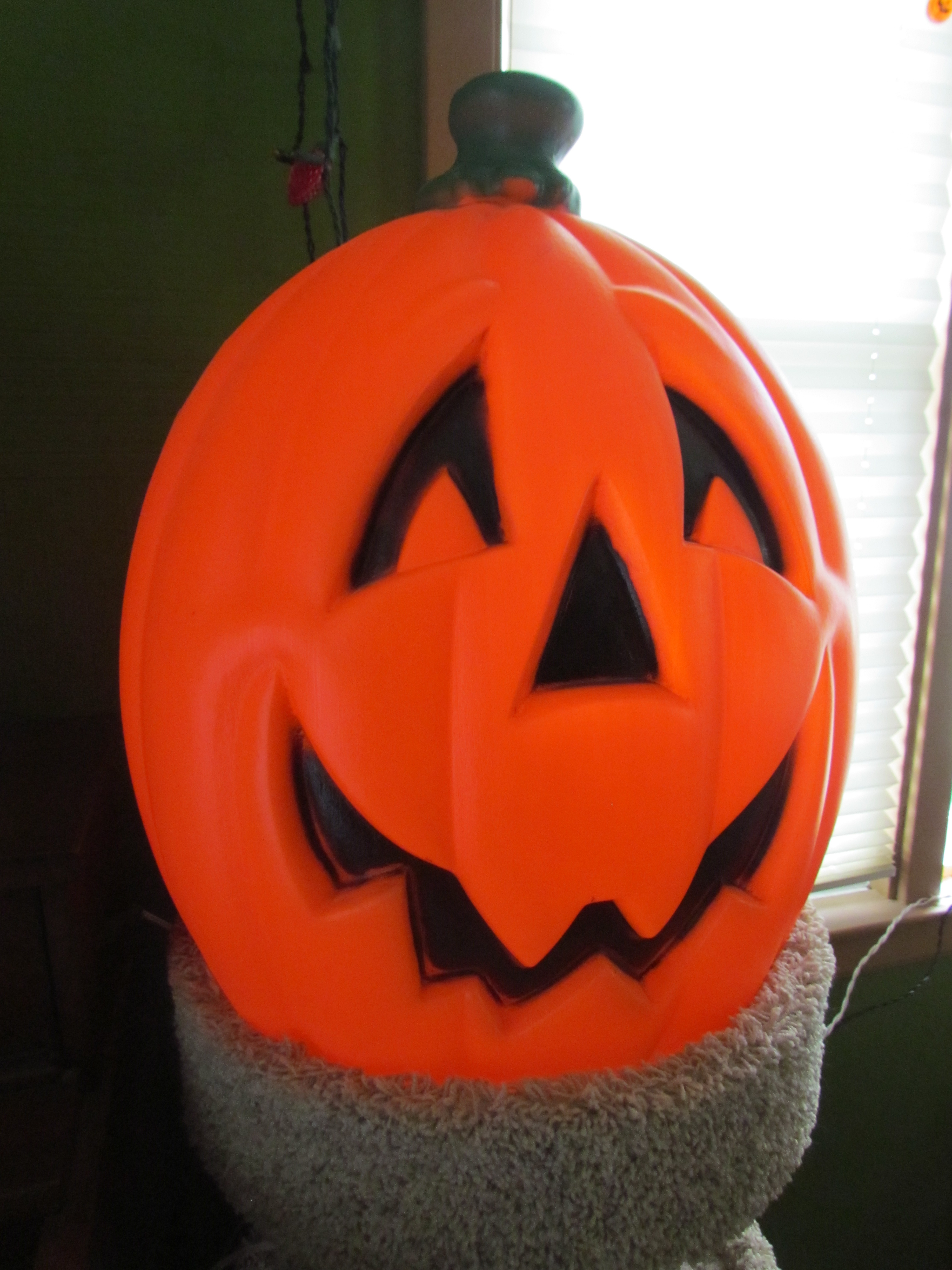
- Big Pumpkin Blow Mold, Wikimedia Commons, source of this guide's photograph.

0 comments